

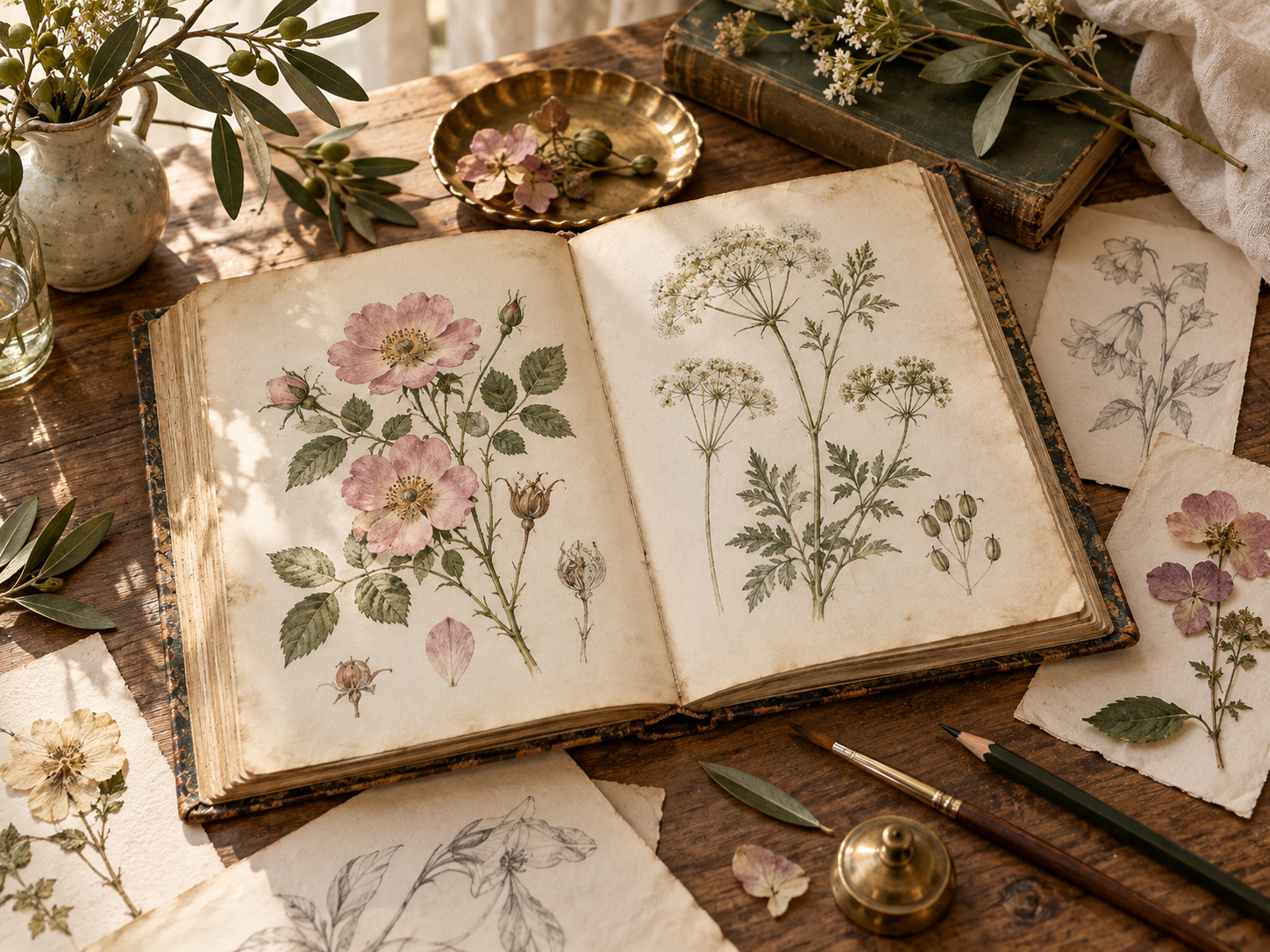
There is something quietly beautiful about the way a botanical illustration invites us to look closer.
A single stem, the curve of a leaf, or the delicate arrangement of petals can become a small study in patience and wonder. Long before photography became widely available, botanical artists carefully recorded these details, preserving the character of plants through line and color.
Even today, these illustrations offer something special: an invitation to slow down, notice what might otherwise be overlooked, and appreciate the artistry found in nature.
The Art of Looking Closely
Botanical illustration begins with observation.
Unlike a casual photograph or a quick sketch, a traditional botanical study often requires careful attention to the form and structure of a plant. An artist may spend hours examining the shape of leaves, the arrangement of petals, or the subtle differences between one species and another.
These details matter because botanical art has historically served both scientific and artistic purposes. Illustrations helped naturalists record and communicate the identifying characteristics of plants, sometimes bringing together details that might be difficult to capture in a single photograph.
But beyond their practical purpose, botanical illustrations reveal something deeply appealing about patient observation.
They remind us that beauty isn't always found in grand landscapes or extraordinary moments. Sometimes it exists in the smallest things: a new leaf unfolding, a flower beginning to open, or the graceful curve of an ordinary branch.
Beauty Preserved on Paper
Vintage botanical illustrations have a character all their own.
Their delicate engraved lines, softly layered watercolors, and carefully arranged specimens evoke an age when nature was often studied through handwritten journals and illustrated field guides.
Many botanical artists worked with restrained colors that reflected the plants before them: earthy greens, muted pinks, warm browns, and soft golden tones.
Over time, the paper itself might develop a gentle warmth, giving these illustrations the familiar character we associate with antique botanical books.
Part of their enduring appeal lies in this combination of precision and softness.
A botanical plate can be carefully observed and scientifically useful while still feeling expressive, graceful, and full of life.
It's a balance that continues to inspire artists, designers, and those who appreciate the quieter beauty of the natural world.
From Nature to Everyday Life
Botanical illustration doesn't have to remain tucked inside an old book.
Its timeless character can bring a sense of calm and natural beauty into everyday spaces, whether through a framed floral study, a favorite journal, a thoughtfully chosen textile, or a botanical-inspired design.
At Larklowe House, we're especially drawn to this meeting of nature, art, and everyday living.
The muted colors, delicate details, and timeless compositions of vintage botanical studies influence the visual language behind our designs.
We love the idea that something as familiar as a flower or an olive branch can become a gentle reminder to appreciate the world around us.
And perhaps that's part of what makes botanical art so lasting.
It isn't dependent on passing trends. Its beauty comes from the natural forms that have inspired artists for generations.
A Quiet Thought to Carry With You
The next time you find yourself outdoors, consider taking a moment to notice one small detail.
The shape of a leaf. The way sunlight passes through petals. The unexpected beauty of a simple wildflower growing beside a path.
You don't need to be an artist or a botanist to appreciate these things.
Sometimes, all that's needed is a willingness to look a little closer.
And in a world that often asks us to move faster, that simple act of noticing can feel like a beautiful beginning.
Larklowe House • Faith • Botanicals • Simple Living